
Demolition & Excavation
Comments Off on Demolition & ExcavationDemolition and excavation are two sides of the same job on many commercial, industrial, and municipal sites. A building comes down. Slabs are broken out. Foundations have to be removed. Buried utilities need to be handled with care. Soil may need to be cut, hauled, stabilized, or prepared for the next phase of construction.
O’ROURKE provides demolition and excavation services for complex project sites where safety, sequencing, and site readiness matter. Our team can coordinate structural removal, selective demolition, concrete removal, foundation removal, excavation, hauling, recycling, and final cleanup under one organized plan.
For property owners, developers, general contractors, facility managers, and public agencies, that matters. When demolition and excavation are handled separately, gaps can appear. Crews wait. Buried obstructions get missed. Change orders pile up. Schedules tighten. With O’ROURKE, the work is planned around the full condition of the site, not just the structure standing on it.
Why Demolition and Excavation Belong Together
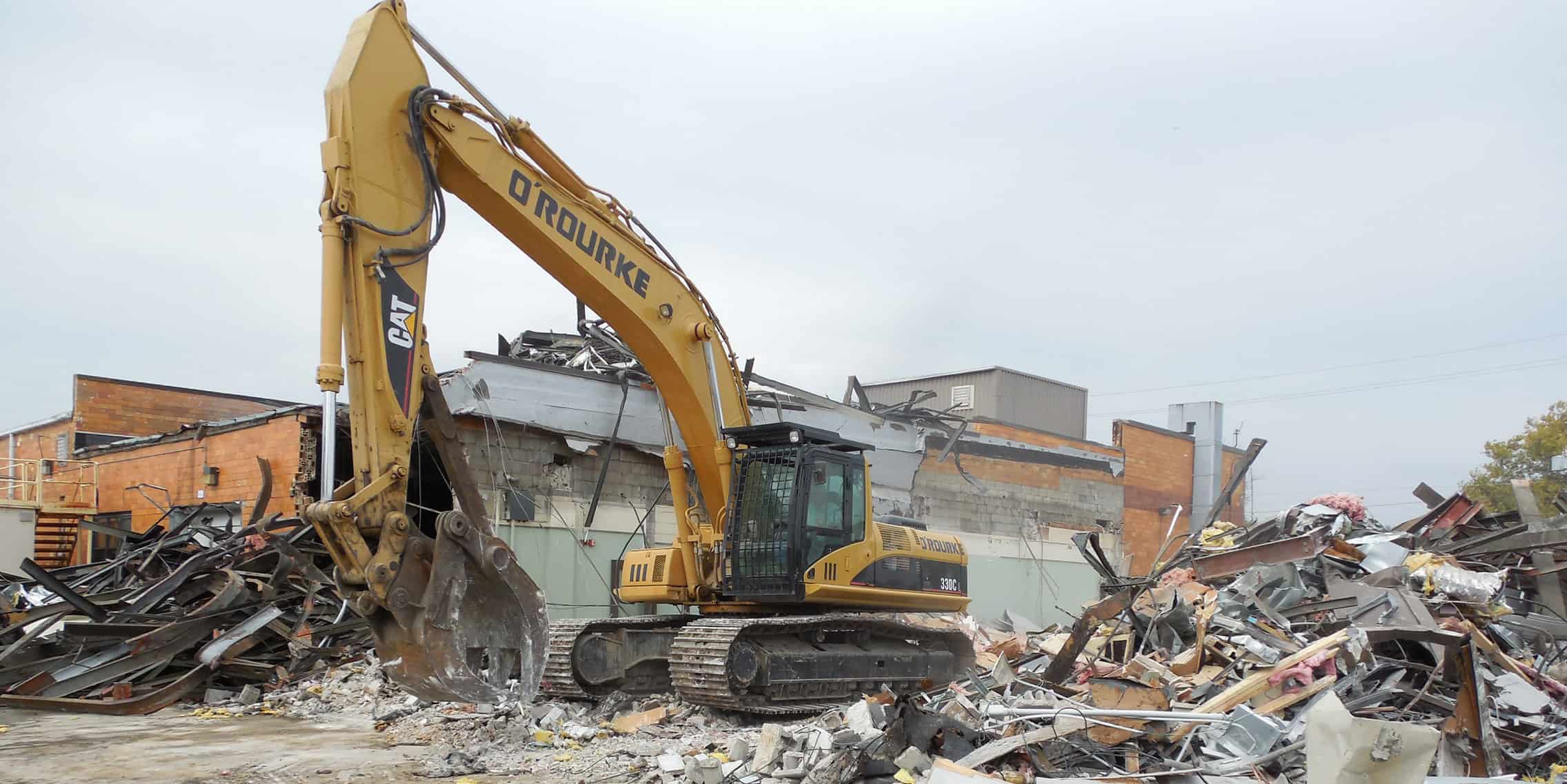
On almost every commercial and industrial project, the line between “demolition” and “excavation” is blurry at best. Foundations, slabs, basement walls, footings, buried utilities, underground storage tanks, and contaminated soils all sit right at that boundary. They’re not really demolition work, but they’re not really earthwork either — they’re both.
When those scopes are split between two contractors, a few predictable problems show up:
- Duplicate mobilization. Two contractors moving equipment on and off the same site adds time and cost that nobody planned for.
- Schedule overlap. The demo crew finishes the structure but can’t leave until the excavator shows up — or worse, the excavator arrives before the demo crew is done, and now there are two trades fighting for the same piece of ground.
- Scope gaps. When something falls between the two contracts (and something always does), the owner ends up paying a change order to whichever contractor is closer.
- Unclear chain of custody. Contaminated soil, recyclable material, and salvaged assets need a clear paper trail. Two contractors mean two waste manifests, two recycling reports, and two opportunities for something to get lost.
A single-source contractor solves all of that by treating the work as what it actually is: one project.
What O’ROURKE Brings to the Demolition Side
We’ve built our demolition capabilities around the reality that no two projects look alike. The right approach for a 30-story tower in a downtown core isn’t the right approach for a manufacturing plant in the middle of an industrial park, and neither one looks like a historic preservation job inside a building that has to stay standing.
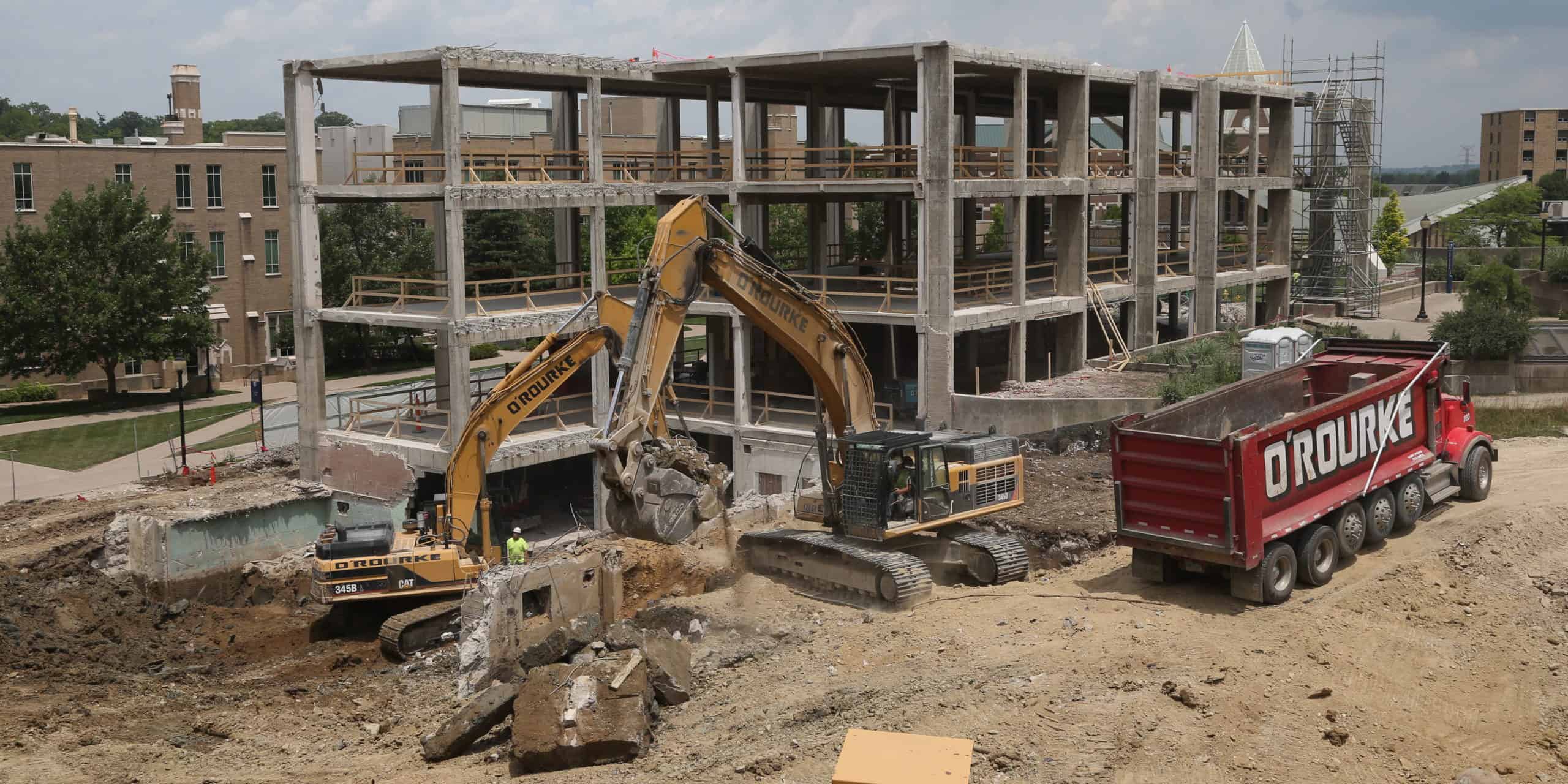
Structural demolition is the bread and butter — high-reach excavators, conventional mechanical takedowns, and the engineering judgment to know which one fits the structure in front of us.
Implosion is the right tool when a structure is too tall, too tight to its neighbors, or too compromised to bring down conventionally. The Beekman Silos in Cincinnati are a good example: 110 years old, 260 feet tall, structurally degraded after a previous contractor’s failed attempt, and surrounded by infrastructure that couldn’t be disturbed. We took the silos down conventionally with a high-reach excavator and felled the headhouse with explosives.
Selective and interior demolition is surgical work — removing specific floors, walls, or systems inside a building that has to keep operating around us. This is common in hospitals, occupied office towers, and historic landmarks.
Dismantlement and deconstruction prioritizes recovery over speed. When the goal is to salvage equipment, preserve historic materials, or recover assets for resale, we slow down and take things apart in reverse order.
Emergency response is for the calls that come in at 2 a.m. — partial collapses, fire damage, weather events. Our crews are equipped to mobilize fast and stabilize the site before the situation gets worse.
Each of these disciplines leads naturally into excavation. Once the structure is gone, the work continues below grade.
What O’ROURKE Brings to the Excavation Side
Our excavation and site work capabilities exist specifically because demolition projects need them. We didn’t bolt on an earthwork division as an afterthought — it’s built into how we approach every job.
Foundation and slab removal is usually the first task after the superstructure is down. Deep basements, thick industrial slabs, and post-tensioned foundations all require different equipment and sequencing.
Underground storage tank removal is one of the most common reasons projects need both demo and excavation expertise. Old tanks have to be drained, cleaned, removed, and disposed of in coordination with environmental regulators — and the soil around them often needs remediation.
Site grading and earthwork brings the parcel to design subgrade so the next contractor can start foundations without re-doing our work.
Utility removal and capping covers water, sewer, gas, and electrical service abandonment. Done wrong, it creates safety hazards and permitting headaches. Done right, it’s invisible.
On-site concrete crushing turns demolished concrete into reusable aggregate. On most industrial projects, we recycle around 95% of the material that comes off the structure — which often means owners avoid the cost of importing fill and exporting debris.
Contaminated soil excavation and disposal runs in parallel with our environmental remediation team. When the dirt itself is the problem, we handle it.
All of this runs on an in-house equipment fleet operated by people who’ve been doing this work for a long time. Every O’ROURKE superintendent has at least 10 years of experience, and most have 20 or more.
What an Integrated Project Actually Looks Like
Here’s the workflow on a typical commercial or industrial demolition project where O’ROURKE handles the full scope:
- Site assessment and engineering. Before anything moves, our team walks the site, reviews structural drawings, identifies hazardous materials, and builds a sequencing plan. This is where most surprises get caught.
- Abatement. Asbestos, lead, and mold come out before structural demolition begins. Doing this in-house means we control the schedule and the chain of custody.
- Demolition. The takedown itself, sequenced to maximize safety and material recovery.
- Recycling and salvage segregation. Steel, concrete, copper, and salvageable equipment get sorted on-site. The recovery values often offset a meaningful portion of the project cost.
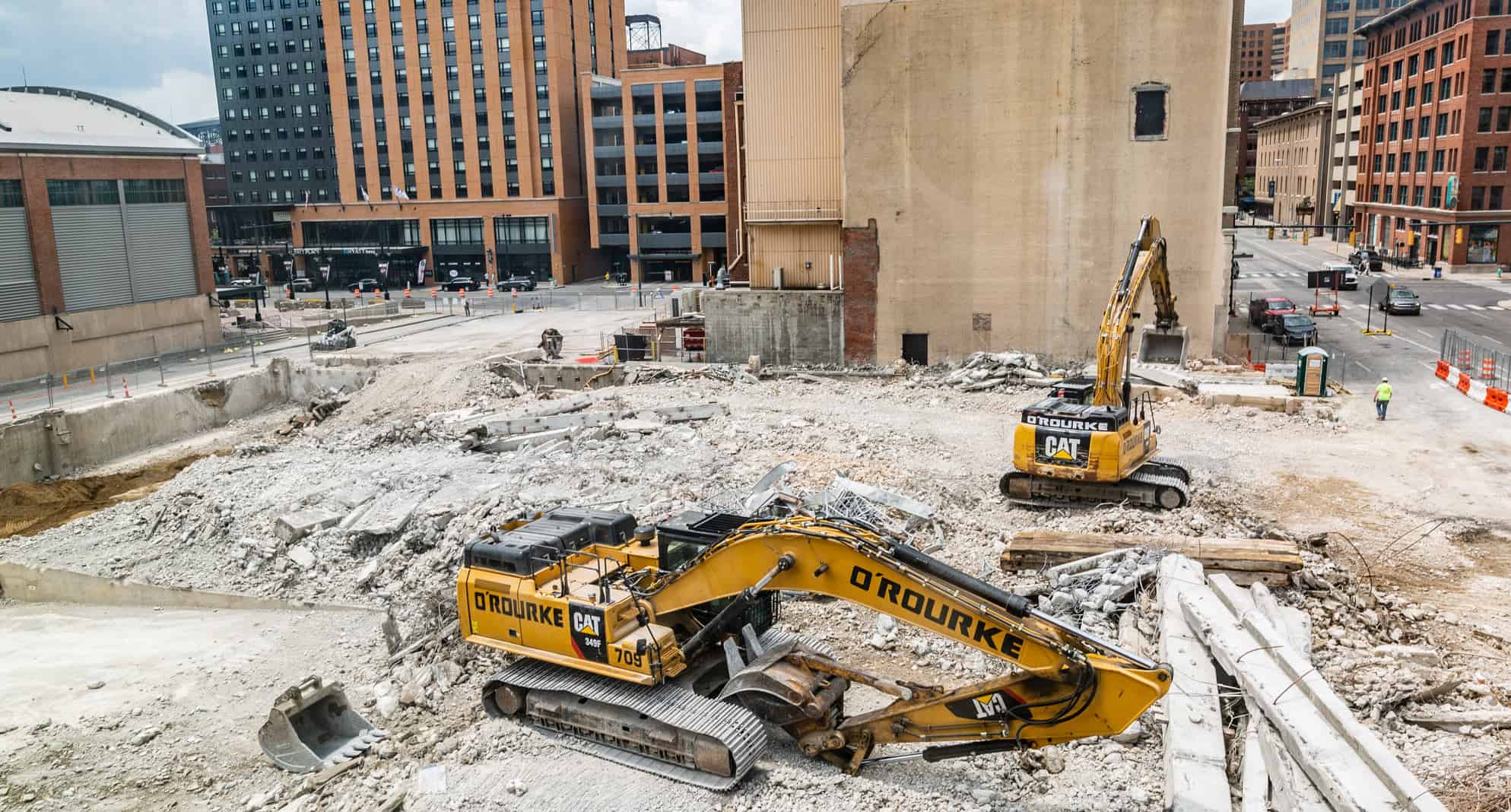
- Excavation and below-grade removal. Foundations, basements, tanks, utilities, and any contaminated soil come out.
- Backfill, grading, and stabilization. The site gets brought to subgrade, compacted, and stabilized.
- Single point of contact throughout. One project manager, one schedule, one safety plan, one set of permits, one phone number to call when something needs to change.
The owner’s experience on a project like this is dramatically simpler than running two contractors in parallel.
Why Owners Choose a Single-Source Contractor
The case for hiring one contractor instead of two isn’t really about preference — it’s about math.
One schedule means no gaps between trades. One safety plan means one EMR (ours is 0.47, well below the industry average). One contractor means faster transition from “site cleared” to “ready for foundations,” which often shaves weeks off the construction start date. The recycling economics work better when the same crew controls both the material coming down and the material leaving the site. Permitting, environmental compliance, and waste manifesting all get easier when there’s one chain of custody instead of two.
And when something goes wrong — because something always does — there’s no finger-pointing. We own it.
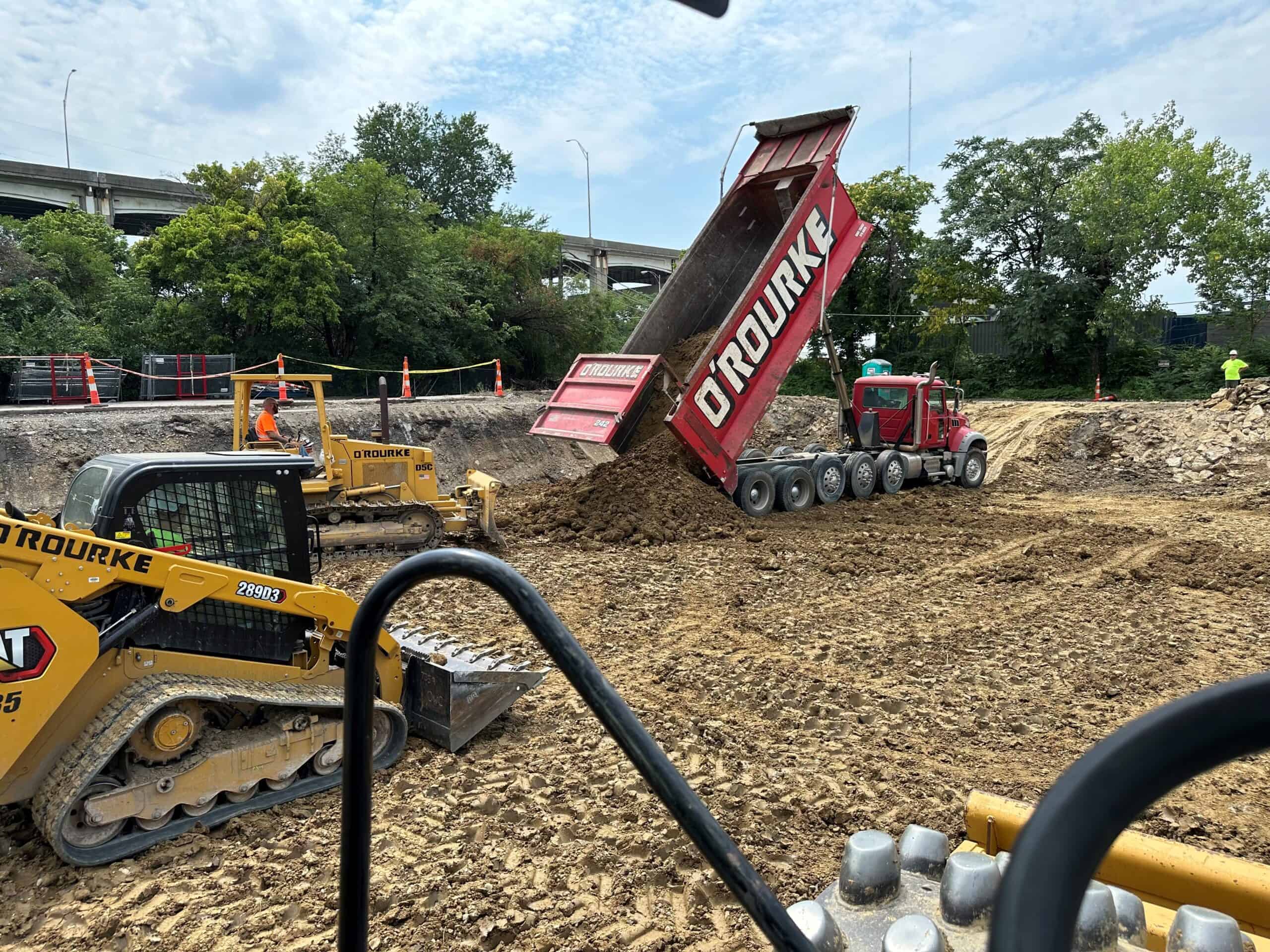
Equipment & Capabilities
Self-performing means owning the iron. O’ROURKE runs one of the deepest specialty fleets in the industry:
- High-reach excavators up to and including the Komatsu PC1250 ultra-high-reach class
- Mobile concrete crushers and screening plants for on-site material processing
- GPS machine control with integrated survey for grade-sensitive excavation
- Specialty attachments — shears, processors, grapples, hydraulic hammers, magnets
- Cranes and heavy haul transport for self-performed mobilization
- Custom fabrication capability for project-specific shoring and bracing
Owning the equipment means we don’t wait on a rental yard, and we don’t pad a schedule to cover someone else’s mobilization.
FAQs About Demolition & Excavation
What’s the difference between demolition and excavation, and do I need both? Demolition removes the existing structure. Excavation shapes the ground beneath and around it. On most redevelopment projects you need both, and running them under separate contracts usually creates schedule gaps and finger-pointing when something doesn’t line up. O’ROURKE handles them together.
Can O’ROURKE handle abatement, demolition, and excavation under one contract? Yes. We self-perform asbestos abatement, lead and PCB remediation, structural and selective demolition, excavation, site utilities, and environmental remediation. A single contract covers all of it.
How do you handle contaminated soil discovered during excavation? Our environmental team runs sampling, segregation, transport, and disposal in compliance with state and federal regulations. Because the same company is already on-site, there’s no work stoppage to bring in an outside remediation contractor.
What’s a typical timeline from contract to shovel-ready? It depends on the scope, the structure, the soil, and the regulatory environment. We can give you a realistic schedule after a site walk and a review of the available drawings. Reach out to an estimator and we’ll get into specifics.
Do you self-perform the excavation work, or sub it out? We self-perform. Crews, equipment, and supervision are all O’ROURKE.
Why Choose O’ROURKE for Demolition and Excavation?
60+ years, family-owned. Founded in 1962 by Patrick H. O’Rourke. Now led by Michele O’Rourke, the first woman CEO and majority owner in the company’s history. WBE-certified through WBENC and NWBOC.
Self-performed across every scope. Demolition, abatement, environmental remediation, excavation, site utilities, concrete crushing, emergency response. One contract. One project manager.
Experienced crews, low turnover. Our superintendents average 20+ years of experience. That depth shows up in the field on the days when something doesn’t go to plan.
Sustainability built in. A 95% recycling rate on industrial projects isn’t a press release — it’s how we keep our clients’ costs down and material out of landfills.
Demolition and excavation work can expose problems fast. A weak structure, unknown utility, buried foundation, unsuitable soil, or environmental concern can change the project in a day. That is why experience matters.
O’ROURKE brings decades of demolition knowledge to commercial, industrial, municipal, and redevelopment sites. Our team understands how to remove structures, manage debris, coordinate excavation, and prepare sites for the next phase of work.
The right demolition and excavation contractor helps protect the schedule, the budget, and the site. O’ROURKE is built for work that requires planning, control, and follow-through.
Request a Demolition and Excavation Estimate
If you need demolition and excavation services for a commercial, industrial, municipal, or redevelopment project, O’ROURKE can help review the scope and develop a practical plan.